


Your shopping cart is empty!
Sweet pepper "Andromeda" F1
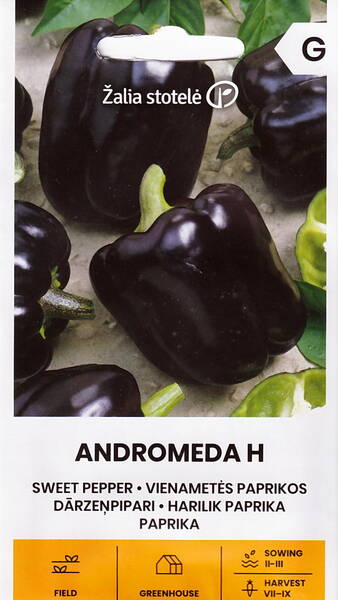
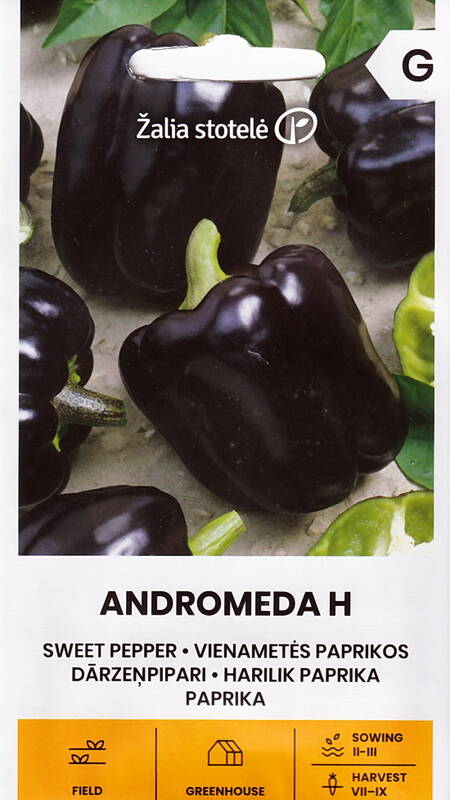
Sweet black pepper “Andromeda” F1.
An early-ripening black-brown cuboid sweet pepper variety for greenhouse cultivation.
Fruits are large, fleshy and sweet, weighing up to 300 g. Number of chambers is 3–4, sometimes two. Fruits are upright at first, later pendulous.
The ratio of fruit length to width is 9.2:9.0. At technical maturity fruits are dark green; at biological maturity they are black-brown, with a very pleasant taste.
A very high-yielding variety.
An early-ripening black-brown cuboid sweet pepper variety for greenhouse cultivation.
Fruits are large, fleshy and sweet, weighing up to 300 g. Number of chambers is 3–4, sometimes two. Fruits are upright at first, later pendulous.
The ratio of fruit length to width is 9.2:9.0. At technical maturity fruits are dark green; at biological maturity they are black-brown, with a very pleasant taste.
A very high-yielding variety.
* Sweet pepper is one of the most demanded vegetable crops.
How to obtain maximum yield in an unheated plastic greenhouse?
SEEDLING PRODUCTION.
When growing sweet pepper in unheated plastic greenhouses, seeds are sown for seedlings in mid-March, and plants are transplanted into the greenhouse at the end of May.
Sowing.
Sowing is recommended in plastic trays or “nutrient cubes”; in this case, the soil clod is not disturbed during transplanting, plants do not experience stress, and seed material is saved.
Seeds are sown to a depth of 1 cm. Crops are covered with plastic film to prevent drying of the upper soil layer. The film is removed when the first seedlings appear.
Optimal conditions.
To ensure uniform germination and emergence within 5–7 days, temperature should be maintained at +25…+30 °C. At +13…+15 °C seedlings appear only after 18–25 days or even later.
During the first 3–4 days after emergence, temperature is reduced to +18 °C; later it is maintained at +25 °C.
Soil moisture throughout the seedling period should be 75–80% of field capacity.
Transplanting.
In plastic trays (3×3×3 or 4×4×4 cm), seedlings grow for 15–20 days until the first true leaf appears, then they are transplanted into larger pots (10×10×10 cm). After leaf closure, spacing is adjusted, leaving 20–25 plants/m² before planting to a permanent place.
Growing with pricking out.
With pricking out, row sowing is carried out in trays with 3–4 cm row spacing. After 20–25 days, at the stage of 1–2 true leaves, seedlings are pricked out into 8×10 or 10×10 cm pots.
Fertilization.
Pepper plants respond well to fertilization. Seedlings are fertilized 2–3 times at intervals of 10–12 days. The first feeding is carried out at the stage of two true leaves (with pricking out — not earlier than 10–15 days after it). Fertilizer concentration must not exceed 0.5%.
Hardening.
To improve survival, seedlings are hardened 2–3 weeks before planting by reducing watering and lowering temperature to +20…+22 °C during the day and +16…+18 °C at night.
PLANTING IN GREENHOUSES.
Seedlings are planted at the age of 50–60 days. By this time plants reach 30–35 cm in height, have 15–18 leaves and open flowers. Before planting, seedlings are thoroughly watered.
Recommended planting schemes: (80+40)×30–35 cm, (80+60)×30–35 cm or (100+60)×30–35 cm. Plants should be evenly spaced: 3–4 per m².
PLANT CARE.
Temperature regime.
Before fruiting, on sunny days, temperature is maintained at +24…+28 °C. At temperatures above +30…+35 °C plants are stressed, dry matter accumulation decreases, buds drop. The same happens when temperature falls to +15 °C or lower.
On cloudy days temperature is reduced to +20…+22 °C during the day and +17…+19 °C at night.
During fruiting: +24…+30 °C on sunny days, +20…+22 °C on cloudy days, +18…+20 °C at night.
Optimal soil temperature is +20 °C. At higher soil temperatures leaf growth intensifies while root system development and fruit set are delayed.
Soil and air humidity.
Adequate water supply improves heat tolerance, yield and fruit quality. Pepper has a weak root system sensitive to salt concentration, therefore watering should be frequent but moderate. Watering is best done in the morning, at the root.
Optimal soil moisture before fruiting is 75% of field capacity, during fruiting — 80%. Irregular watering may cause fruit cracking.
Relative air humidity in the greenhouse should not exceed 65–77%; higher humidity makes pollen non-viable, flowers and ovaries fall off.
Fertilization.
Plants are fertilized every two weeks. The first feeding is carried out 15 days after rooting. Organic fertilizers are very effective: mullein diluted 1:10 with added superphosphate (20–30 g per 10 l). Application rate — up to 5 l/m².
Plant formation.
As the plant grows, it is formed. First the main stem develops, then after 10–12 leaves 2–4 first-order side shoots appear. Two strongest shoots are left to form the “skeleton” of the plant, the rest are pinched. Skeletal shoots are tied to trellises.
At each branching (“fork”), the strongest shoot is left, the weaker opposite one is pinched above the first leaf. The first (crown) flower must be removed to avoid growth delay and yield reduction.
During flowering, plants are gently shaken daily for better pollination; bumblebees may also be used.
HARVESTING.
Harvesting is carried out as fruits ripen, 1–2 times per week. Fruits are harvested at both technical (green) and biological (colored) maturity.
Sweet pepper is extremely rich in vitamins. By vitamin C content (up to 400 mg%) it surpasses most vegetables and fruits, except black currant and rosehip.
* Peppers are not only thermophilic and water-demanding but also very light-demanding.
* Since the root system of these crops is located in the upper soil layer, loosening should be shallow (3-5 cm).
* Fresh manure is not added to the bed before planting peppers, otherwise, they will give a strong leaf mass.
* Young seedlings of peppers planted in a garden bed cannot withstand low positive temperatures (+2+3°C), and autumn fruit-bearing plants can withstand frosts down to -5°C. This allows you to keep the plants until late autumn.